By June O’Sullivan and Sophie Pallash, LEYF and London Institute of Early Years
Early Childhood Education and Care settings offer the foundation on which lifelong pro-environmental and sustainable attitudes can be built (Ärlemalm-Hagsér, 2013). If we are serious about sustainability, we must recognise children as citizens from the earliest stages of life. They have the right to be engaged in social and environmental issues and to be heard so that they can grow into sustainability-focused adults. Citizenship is not something that suddenly appears at eighteen. It begins much earlier, shaped by experiences, relationships and the everyday opportunities children have to notice, question and act.
That is why children’s rights matter so much in this conversation. The UN Convention on the Rights of the Child has become increasingly explicit about the environmental conditions children need in order to thrive. Article 26, as often cited in child rights discussions, and the wider UNCRC framework, underline the state’s responsibility to protect children and families from environmental shocks and slow-onset harms, including climate change (UNCRC, 1989). Children have the right to a clean, healthy and sustainable environment. This requires more than goodwill. It calls for deliberate policy action, regulation and accountability, including scrutiny of business practices that harm children’s environments. Retrogressive steps that weaken environmental protections are fundamentally incompatible with children’s rights.
That might sound like a “big policy” argument, far away from a nursery room. But it isn’t. The climate crisis is already playing out in children’s daily lives: heat, air quality, flooding, anxiety, loss of green space. Early years is not too early for these conversations. It is exactly early enough.
Voice is not just what children say
Listening to children is essential if we expect them to participate in sustainability. Their perspectives help them recognise problems, search for information and explore solutions in their local environment, their communities and increasingly, globally (Pramling Samuelsson and Kaga, 2008; Wolff, Skarstein and Skarstein, 2020).
Aistear (2024) pushes us further by expanding “voice” beyond speech. It includes silence, cries, utterances, expressions, actions, reactions, song, mark-making, the arts and conversation. If we take that seriously, then “listening to children” becomes more than a tokenistic question at group time. It becomes a disciplined practice: noticing, making space, interpreting carefully, being reflexive about adult bias, and acting on what we hear.
This aligns with contemporary thinking about children as global citizens and active beings, not simply “becomings” waiting for adulthood (James and Prout, 2015). Children are already in the world. They are already reading it. They are already forming judgments about what feels fair, safe, caring and responsible.
Anyone who has ever been told off by a four-year-old for dropping litter or wasting water knows this. Children can be fierce protectors of what they love. Their moral radar can be startlingly accurate. They model sustainable behaviour with a kind of clarity that adults often lose, whether that is protecting the natural world or showing compassion through simple acts of kindness, like feeding birds or worrying about an injured animal (Spiteri, 2020).
We ignore babies, toddlers and young children at our peril (Davis and Elliott, 2014; Santone, 2019; Skehill and Daly, 2023). Their intuitive sense of fairness, care and responsibility is not a cute add-on. It is a resource for our collective future.
Neighbourhoods are curricula too
Embedding sustainability in early years must be rights-based, respectful and authentic to children’s lived realities. It requires creating democratic spaces where children can encounter real-world issues and explore them in meaningful ways.
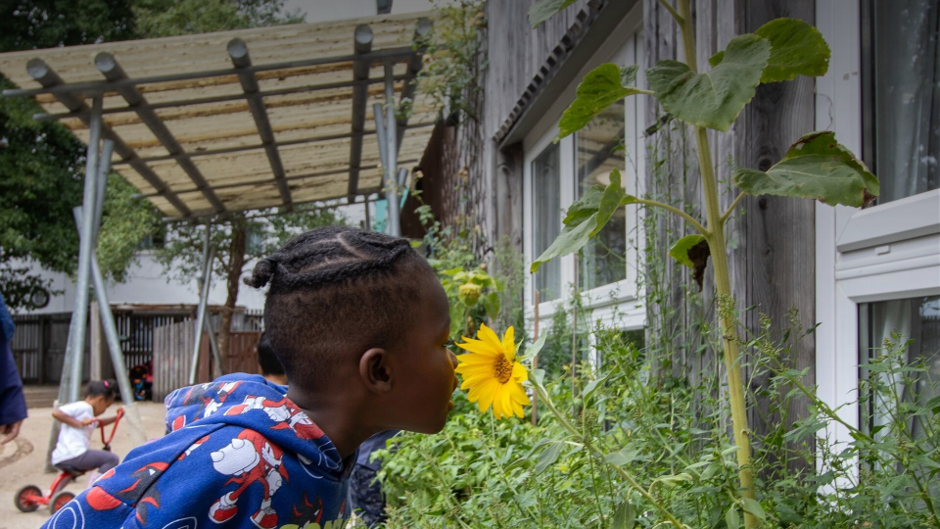
One powerful approach is to engage children with their local neighbourhoods. Exploring local places deepens environmental awareness and can foster early environmental stewardship (Washinawatok et al., 2017). King (2022) showed how preschool children used photography to document nature in their neighbourhoods, revealing perceptive understandings of their environments and why caring for them matters. Stewardship here is not a lecture. It is a relationship, built through repeated experiences like gardening, recycling, noticing living things, conserving resources and caring for places that children come to see as “ours” (Clayton et al., 2014).
Research tells us that very young children can develop ecological knowledge. Waxman et al. (2018) found that four-year-olds from diverse communities developed early understandings of ecological relationships through interaction with their surroundings. McClain and Vandermaas-Peeler (2016) observed children demonstrating stewardship behaviours like litter-picking and recycling and recognising the impact of their own choices. Engdahl and Rabušicová (2011) found emerging environmental awareness among three-year-olds during visits to a state park, deepening with age.
But here’s the rub. Much of this knowledge sits in pockets. Too often, studies remain disconnected from daily professional dialogue in ECEC. There is limited focus on how educators can curate and facilitate these conversations, connect colleagues and build cumulative professional knowledge about environmental thinking, decision-making and problem-solving (Nolet, 2009; Heimlich, Adams and Stern, 2017).
This is where we believe our work contributes. Not because we have “the answer”, but because we are trying to build a bridge between children’s lived experiences, educators’ professional learning and the kinds of methods that make children’s thinking visible.
Why we used cameras: children’s perspectives through their own lens
Our work is grounded in a participatory paradigm because it focuses on collaboration and empowerment, giving children an active role in co-creating knowledge (Heron and Reason, 1997). It fits naturally with photography as a research method: children document what matters to them, and meaning is explored through dialogue around their images.
A participatory paradigm is built on relational ontology. We understand the world through people’s experiences in specific contexts, and knowledge is developed through self-reflection and reflexive dialogue aimed at action and change. There are multiple ways of knowing, and knowledge should be democratically created through collaborative inquiry (Wood, 2020).
Because of our positionality, our methodology was shaped by our pedagogical values and participatory ethos (Wall, 2018). We therefore paired this paradigm with an action-oriented methodology and used participatory action research. The children were not just “participants”; they were engaged in the design and the process, with control over pace and direction. As Lundy (2012) reminds us, participation requires more than expressing views. Children may also need support in forming them, because they have the capacity to develop their own perspectives on matters affecting them.
In practice, children in four London nurseries took cameras on a “research walk” within a half-mile radius of their nursery. They photographed what they disliked in their local environment. The adults did not define “dislike”; the children did. We listened, clarified, and stayed alert to our own bias (Roa et al., 2018). On returning to the nursery, the photos were displayed and children selected images they wanted to keep, agreeing on deleting repeats or blurred images. This mattered because it ensured children remained active decision-makers in the research process and supported participation for children whose communication is not always primarily verbal.
The children’s words were strikingly consistent: “disgusting”, “smelly”, “yucky”, “I don’t like rubbish on the floor”, “feel like I need a bath after it.” They were troubled by litter, dog and bird mess, roadworks, and sometimes by “shadowy and ugly” buildings. They noticed small patches of grass and flowers as pleasant. They held adults responsible, describing grown-ups doing “bad things” by not cleaning streets. And their familiarity with public spaces differed depending on whether they travelled by bus or car. Children who used public transport were far more attuned to the geography of their everyday lives.
What we learned, and what we’ll share at BECERA
This research taught us things we did not anticipate. For example, in settings where children usually arrive by car, we realised we need a preparatory walk to gauge how long children can sustain concentration. We also learned that cameras need to become part of everyday practice, not a novelty, so children can use them as a regular tool for representing thinking and feeling, rather than a one-off event that produces blurred excitement.
We’re now planning narrated photo exhibitions in each nursery for parents and staff. The purpose is not to show off the research. It is to shift the narrative: children are not passive recipients of adult-designed sustainability activities. They are environmental stewards with something urgent to say about the spaces they inhabit.
At BECERA, we’ll go deeper into what children photographed, how we analysed the conversations and images, the ethical complexities, the role of the teacher as co-researcher, and what this means for sustainability pedagogy in ECEC. But for now, I’ll leave you with one thought.
If sustainability is about interdependence, responsibility and the conditions for collective flourishing, then young children are not too young for it. They are already living it.
And perhaps the real question is not whether children can participate in sustainability.
It is whether we adults are brave enough to build early years environments that truly allow them to.
We look forward to seeing you at BECERA.
If you’re interested in this, you may also like:
Pramling, N. and Samuelsson, P. (2025) ‘Engaging children in what-if thinking through read-aloud conversations in early childhood education for sustainability’, European Early Childhood Education Research Journal, 33(2), pp. 211–222. https://doi.org/10.1080/1350293X.2024.2437760
Ranta, M. (2023) ‘‘Can we see our voices?’ Young children’s own contributions to authentic child participation as a pillar for sustainability under the United Nations Convention on the Rights of the Child (UNCRC)’, European Early Childhood Education Research Journal, 31(6), pp. 914–931. https://doi.org/10.1080/1350293X.2023.2214716
Carretón Sanchis, A., García Ferrandis, I. and García Gómez, J. (2022) ‘The systemic vision of the environment through drawing of young Spanish children’, European Early Childhood Education Research Journal, 30(5), pp. 773–790. https://doi.org/10.1080/1350293X.2021.1992465