Young Carers in Early Childhood - A relational ontology of young children's living experiences of caregiving.
By Carly Ellicott

Young carers are no longer invisible in policy conversations, but the youngest among them are often still underrepresented (Ellicott et al, 2025). Children in early childhood who live with and are impacted by a family members’ illness, disability, mental health needs, substance abuse or complex needs are rarely recognised as having caring responsibility, or vulnerability of increased caring responsibility over time (Ellicott et al, 2025a). As a result, access to their legal rights to a young carers needs assessment, referrals to specialist services, or formal support pathways are limited (Ellicott et al, 2026). Many are already negotiating responsibility, emotional labour, and relational care long before the term “young carer” is ever considered for them (Carers Trust, 2023).
This strand of research is presented as the fourth output from my PhD programme at the University of Plymouth. Together, the programme addresses a significant gap in the literature: the underrepresentation of young carers in early childhood and the implications this has for early years practice, safeguarding, and whole-family support.
Why early childhood matters
Early childhood practitioners are uniquely placed to notice when caring responsibilities begin to shape a child’s everyday life. However, current narratives often rely on verbal disclosure, age-based assumptions, or quantifying visible tasks of care. Young children may not have the language to describe their experiences, and their meaning making of caring responsibility may more likely be embedded in their play, daily routines, attachment behaviours, or emotional attunement to others. Conversely, when children are able to clearly express their needs and caring activities, professionals do not always recognise or understand what is being presented to them (Ellicott et al, 2025a).
Understanding experience through relationships
The research is grounded in a critical constructivist philosophical orientation, recognising that children’s experiences are subjective and shaped through social interaction. A relational ontology further informs the work, emphasising that children’s lived experiences cannot be understood in isolation.
Moving beyond words: why methods matter in practice
Traditional approaches to assessment of need can unintentionally exclude young children’s voices. Visual and creative methods enable young children to communicate meaning in developmentally appropriate ways. Young carers in early childhood were invited to take part by drawing a picture, writing a story or a poem that they felt was important to their caring role. All children were supported by a specialist young carers service, with a dedicated trusted adult who continued their support their needs after the research activity ended.
The drawings shared help inform us of their experiences, understand what is important to them and how they are making sense of their worlds. Outcomes raise questions for future practice. They highlight a need to evaluate the efficacy of current systems and assessment practices to ensure they include the range of methods needed to gather the relational and emotional information we need in order to tailor support for young children who care.
This research broadens understanding of what it means to be a young carer in early childhood and challenges existing policy assumptions. The following infographic helps to define key points for reflection.
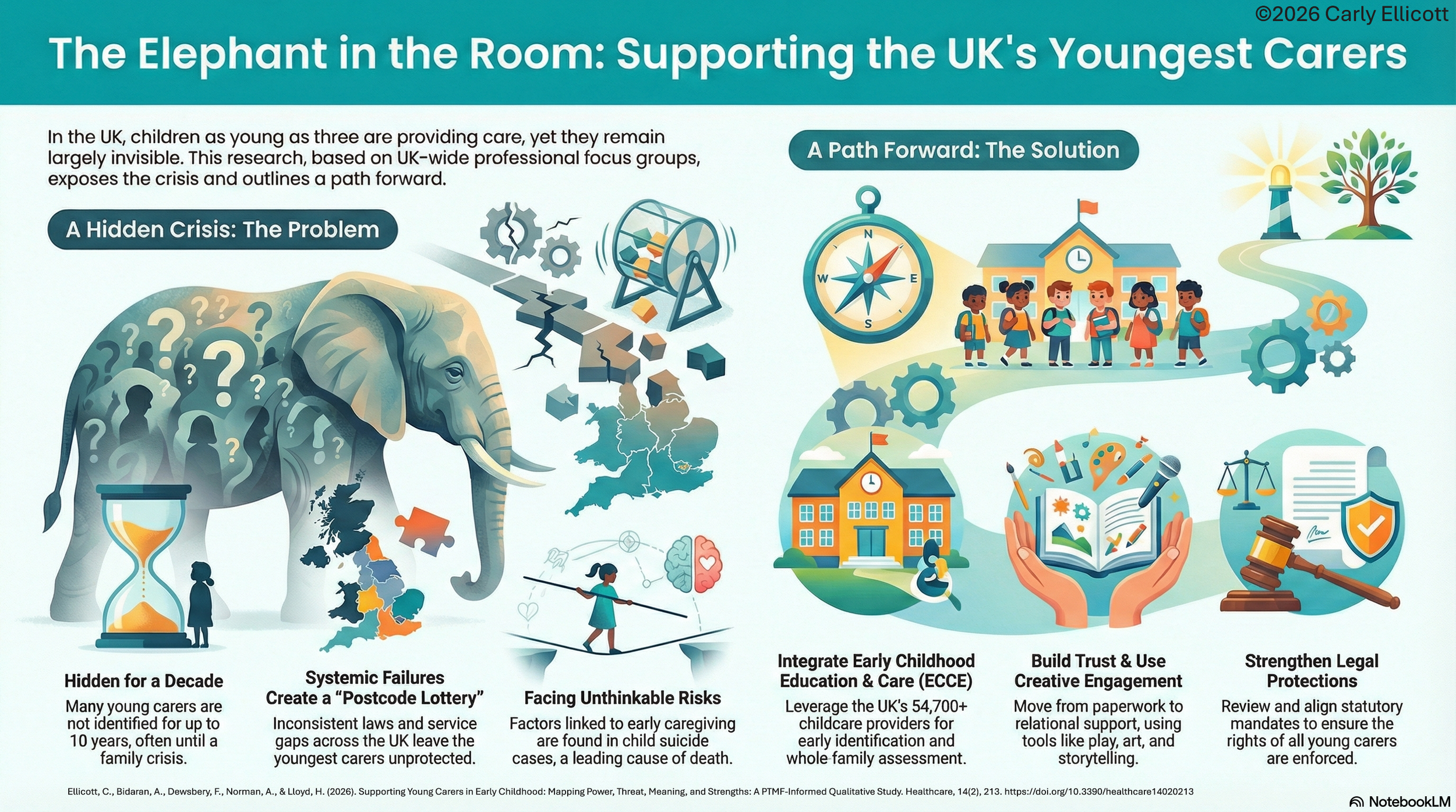
After publication of the original paper, a generative AI tool was utilized to create this image. Google NotebookLM
Carly Ellicott is a PhD Candidate at the Faculty of Health, School of Psychology, University of Plymouth.
To learn more about the research you can contact Carly here : Miss Carly Ellicott - University of Plymouth and via LinkedIn
Previous BECERA guest blog post: Young carers in early childhood - creating threads of hope through lived experience. — CREC
References:
Ellicott, C. (forthcoming). Young carers in early childhood: A relational ontology of young children’s lived experiences of caregiving. University of Plymouth.
Carers Trust . All-party parliamentary group inquiry lays bare the Impact on life opportunities of young carers [Internet]. https://carers.org/downloads/appg-for-young-carers-and-young-adults-carers-reportlr.pdf. Carers Trust; 2023 [cited 2023]. Available from: https://carers.org/downloads/appg-for-young-carers-and-young-adults-carers-reportlr.pdf
Ellicott, C., Ume Rubab, S., McGowan, A., Neale, B., Bidaran, A., Dewsbery, F., Norman, A. and Lloyd, H. (2024). Young Carers in Early Childhood – Scoping Review. How Are Young Carers Represented in Broader Literature and What Factors Influence Dominant Representations of Young Carers in Early Childhood in the UK? Healthcare. doi: https://doi.org/10.20944/preprints202412.0014.v1.
Ellicott, C., Jones, S., Jones, S., Felicity Dewsbery, Norman, A. and Lloyd, H. (2025a). Young Carers in Early Childhood—Exploring Experience with the Power Threat Meaning Framework. Family Science, [online] 1(2), pp.8–8. doi: https://doi.org/10.3390/famsci1020008.
If you’re interested in this, you may also like
Street, M. (2022). Eliciting young children’s ‘voice’ in low-income areas in England: recognising their mutuality of being. European Early Childhood Education Research Journal, 30(1), 96–107. https://doi.org/10.1080/1350293X.2022.2026433
Fitzpatrick, A., & Halpenny, A. M. (2025). Educators as enablers of young children’s voice and agency in research: messages from an Irish study on Intergenerational Learning. European Early Childhood Education Research Journal, 1–17. https://doi.org/10.1080/1350293X.2025.2541327