By Maulfry Worthington and Elizabeth Carruthers
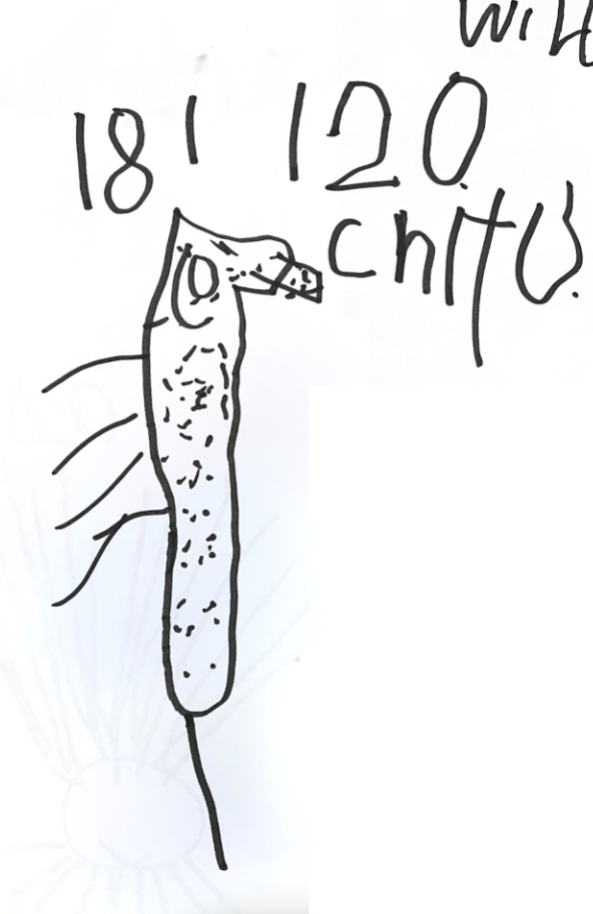
William explained he’d drawn a cheetah with lots of spots,
“I would guess 89 maybe, the numbers are its size and I measured how long with the ruler.”
Mathematics that belongs to the child
In England education has been under threat for many years, dogged by frequent curriculum changes and increasingly severe Ofsted inspections. The first introduction of the National Curriculum into schools was in 1989, and since then successive governments have tightened their hold on teachers’ pedagogy and children’s freedoms to learn. In primary schools Reception teachers have suffered from a ‘push-down’ and ‘school-readiness’ has resulted in increasingly formal approaches, with the result that play is often marginalised. Whilst the Early Years Foundation Stage Curriculum (DfE, 2025) emphasises play, the curriculum asserts, ‘Children learn through play, by adults modelling, by observing each other and through adult-guided learning’ (p. 7); however, ‘adult-guided learning’ is far from children’s own play, and many consider it as the antithesis of play.
In recent years the greatest control has been exerted over literacy (synthetic phonics) and mathematics. Mathematics in Reception has been dominated by ‘Maths Mastery’ from Asia, an approach with little room for teachers to determine how they might teach. In classrooms worksheets are still used in the form of work-books from published schemes, yet there is no published research that provides evidence of their efficacy for children’s mathematical learning. Such narrow approaches support only superficial understanding. What is missing is space for children to develop their understanding of the written symbolic language of mathematics in their own ways. Previous research (e.g., Hughes, 1986) showed the difficulties children often experience with the symbolic written language of mathematics.
In 1990 in our own classrooms, we began researching children’s mathematics, children’s own mathematical explorations, thinking, and representations in which they freely engage. Such behaviours have been increasingly difficult to find in England since children need open and democratic classroom cultures in which adults understand, appreciate and support children’s own thinking and notations. We term children’s own emergent mathematical notations ‘Children’s Mathematical Graphics’.
We have been fortunate in that in 2023 we were invited to participate in South Australia’s ‘Numeracy Summit’ aimed at early childhood educators (teachers and other early childhood professionals). Our latest research has involved us working with early childhood teachers in South Australia (SA), in a year-long project (2025 – 2026). In this we engaged in participatory teacher-research through collaborative dialogue via online ‘Teams’, in order to support their understandings of children’s emergent understandings of the abstract ‘written’ language of mathematics, as they transition from home to kindergarten and school.
The South Australian curriculum (The Early Learning Framework for Australia, 2022) is more open than that of England, and the use of worksheets is uncommon. The curriculum ‘focuses on capabilities and skills such as problem solving and meta cognition strategies that enable deeper thinking, solving real world problems, reflection and a holistic approach to learning… encouraging high[ly] responsiveness’ and creativity (Education Lead, Early Childhood, SA).
Our preliminary findings highlight these teachers’ growing understanding and enthusiasm for an open approach to mathematics, showing shifts in their pedagogy evidenced by their increasing openness, explanations of the children’s graphics and their post-project responses. These changes underline the importance of children’s agency in mathematics and the power of teachers’ agency for their pedagogy. Children’s Mathematical Graphics do not replace the curriculum, but our extensive research, mostly in the UK and from Australia, show that they are an important and often overlooked aspect of the curriculum in almost all schools and settings.
Our preliminary findings of this collaborative teacher-research have been welcomed in SA. Sadly, we recognise that in the England’s current educational climate such a project would come against barriers (Carruthers, 2022). More than ever, we need openness and democracy that truly acknowledges the significance of the child’s role as central in her learning.
We argue that children need freedom to explore and communicate their own mathematics, and that in early childhood education, mathematics should belong to the child.
About the authors
Elizabeth and Maulfry are the originators of Children’s Mathematical Graphics and have researched this important aspect for more than 30 years. Their seminal work ‘Children’s mathematics: Making marks, making meanings’ (2nd edition, Sage, 2006) continues to win much acclaim and was highlighted in the Williams Mathematics Review (DCSF, 2008), and they were commissioned by the government to write ‘Children’s mathematical thinking’ (DCSF, 2009). They have published extensively, and their work is internationally known.
Elizabeth Carruthers has taught in schools in England and the United States. She has worked in the advisory service as an early years and numeracy consultant. Elizabeth was the Executive Head of a Nursery School and National Teaching School. Her Phd is titled, The Pedagogy of Children’s Mathematica Graphics: Teacher Perspectives (2022). Recent publications include:
Carruthers, E. (2023). Early Years Teachers Perspectives on their Pedagogies of Play and Mathematics. Impact Journal. Issue 19
Carruthers, E. (2020). Mathematical teaching in nursery schools in England: Pretend play and democratic pedagogies. Review of Science, Mathematics and ICT Education 14(2), 25-41.
Maulfry Worthington taught children from 4 – 8 years of age for many years, and in addition to lecturing in higher education, was a numeracy consultant, and worked as an e-learning facilitator at the National College for School Leadership, managing early years online communities. Her PhD focused on the emergence and development of young Children’s Mathematical Graphics, explored through their spontaneous pretend play. Recent publications include:
Worthington, M. (2018). Funds of knowledge: Children’s cultural ways of knowing mathematics. In V. Kinnear, M-Y Lai & T. Muir (Eds.), Forging connections in early mathematics teaching and learning (pp. 239-258). Springer.
Worthington, M., & Van Oers, B. (2016). Pretend play and the cultural foundations of mathematics. European Early Childhood Education Research Journal 24(1). 51-66.
For full details of our work, see: The Children’s Mathematics Network: www.childrens-mathematics.net
References
DfE, SA. (2022). Belonging, Being and Becoming: The Early Learning Framework for Australia. https://www.acecqa.gov.au/sites/default/files/2023-01/EYLF-2022-V2.0.pdf
Carruthers, E. (2022). The Pedagogy of Children's Mathematical Graphics: Teacher Perspectives. (Doctoral Dissertation). University of Bristol.
The international Children’s Mathematics Research Network: https://www.childrens-mathematics.net
DfE. (2025) The Early Years Foundation Stage Statutory framework. https://assets.publishing.service.gov.uk/media/68c024cb8c6d992f23edd79c/Early_years_foundation_stage_statutory_framework_-_for_group_and_school-based_providers.pdf.pdf
Worthington, M. (2021). The emergence and development of young children’s personal mathematical inscriptions: The evolution of graphical signs explored through children’s spontaneous pretend play. [Doctoral Dissertation]. Vrije Universiteit, Amsterdam.