by Kay Davey, University Centre Somerset
Neurodiversity recognises the variety of ways people think, process, interact, function and belong in the world (Wise, 2024). Whilst recognition of neurodiversity has increased across education, discussions in the sector rarely include the neurodiversity of the education workforce (Caryll et al., 2024). My research centred the voices of neurodivergent-identifying early years professionals in reflecting on their experiences in the early years workforce and revealed relational and environmental conditions which contribute to professional flourishing or burnout.
Central to the research was a commitment to an ethics of care and respect for both the participants and myself. Using the guiding principles within the EECERA ethical framework, it was important to make sure all participants were “treated in a way which promotes inclusion and honours all identities” (Bertram et al., 2025:6). An anonymous, online questionnaire adopting neuro-inclusive approaches captured 76 responses. This blog post discusses how informed consent, participant wellbeing and researcher wellbeing were ethically considered when working as a neurodivergent-identifying researcher with neurodivergent-identifying participants.
Informed Consent
An ethical responsibility to empower voluntary, informed and consensual participation from neurodivergent-identifying educators (Bertram et al., 2025) needed careful consideration. Traditional methods in online questionnaires involve written information about the study and clarify the right to withdraw (Walliman, 2020). However, consent is often implied through completion and there is no way of ensuring participants have understood. Additionally, written formats may cause barriers to engagement (Nye, 2025), particularly when accounting for neurodiversity. Attempting to actively address such barriers, I provided multiple methods of engaging with participant information. A detailed written participant information sheet was adapted to clarify technical language, simplify sentence structure and minimise cognitive load. Additionally, the questionnaire introduction contained a simplified version of this along with a video of myself discussing the information and introducing myself and my positionality (Nye, 2025).
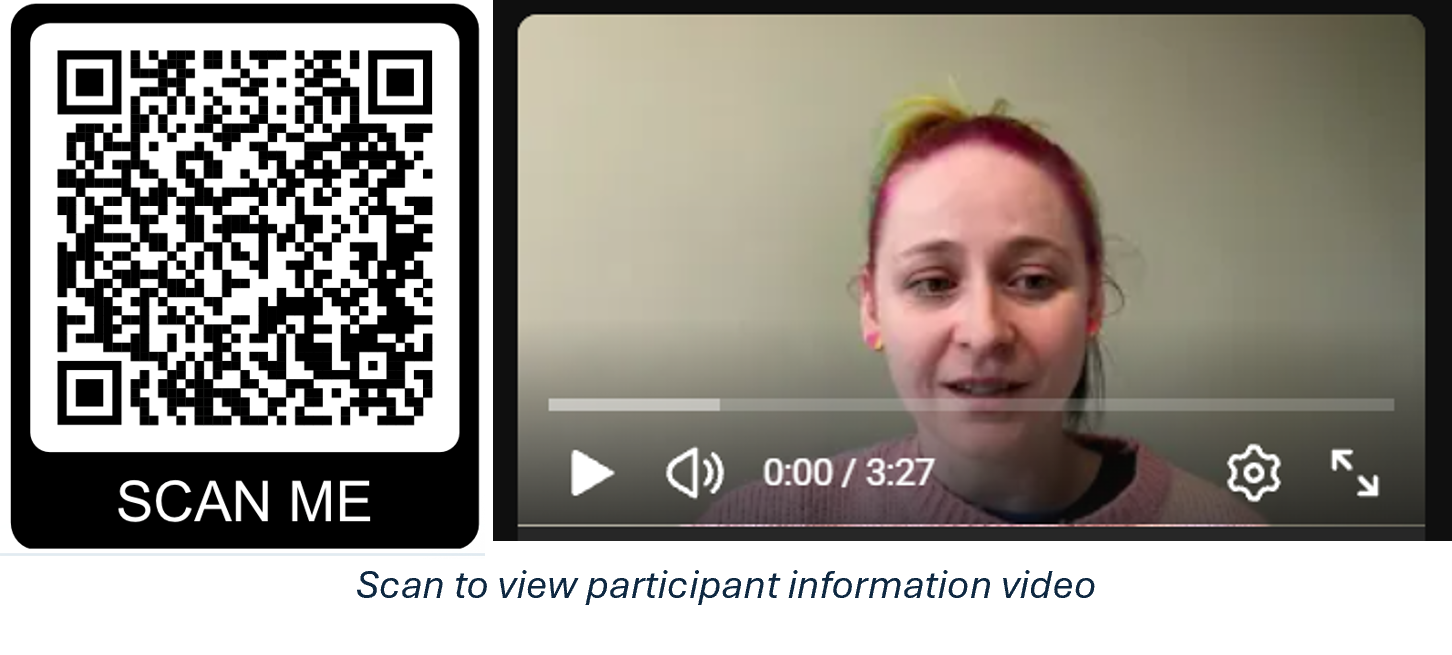
Screenshot of the consent video
This offered an alternative to written formats and humanised the research, aiming to virtually build connection with the participants which is particularly important when asking to reflect on personal topics. The consent video received significant engagement from participants. Finally, the first question required participants to actively consent to continue the questionnaire ensuring all participants engaged in this process.
Neurodivergent-identifying participants’ wellbeing
Acknowledging the sensitive nature of the research and conscious that neurodivergent-identifying individuals often experience heightened emotional burden and mental health challenges (Lukito et al., 2025), participant wellbeing was a key consideration. In addition to the informed consent, practical actions were taken to avoid or support any emotional distress:
Participants maintained the right to participate actively or passively (Bertram et al., 2025), being able to skip any non-consent-based questions.
Question order supported progressive reflection.
Videos for each question supported accessibility and understanding.
Links to relevant support structures in participant information and at the end of the questionnaire.
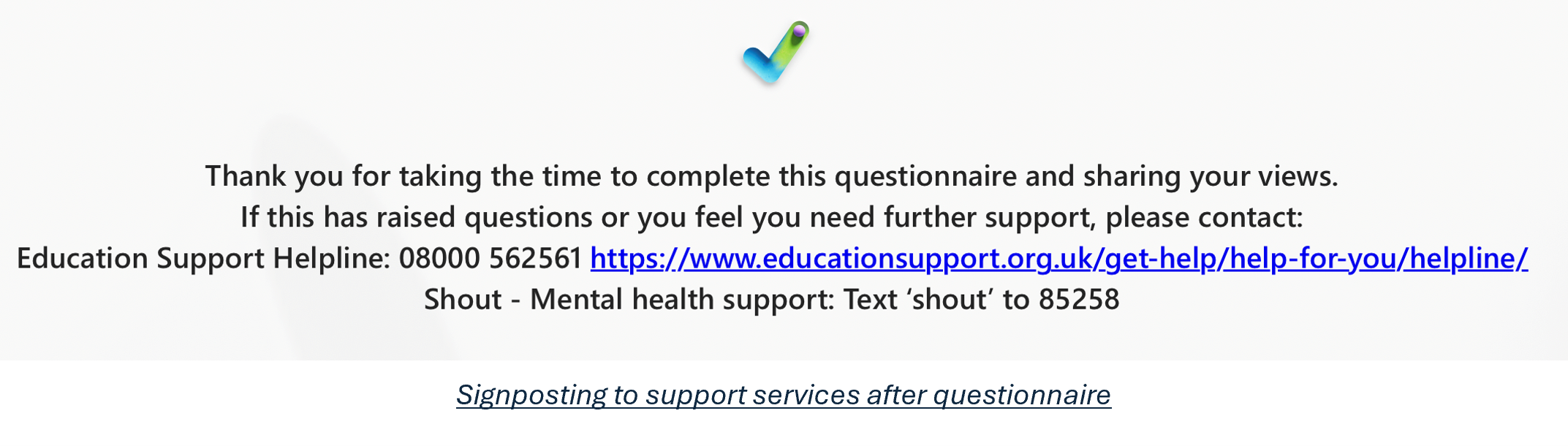
Screenshot of the message received after questionnaire submission
Neurodivergent-identifying researcher wellbeing
My ‘insider’ position as a neurodivergent-identifying early years professional was critical. Neuroinclusive research emphasises the ethical importance of neurodivergent-identifying researchers carrying out research with neurodivergent-identifying participants (Dark, 2024; Kara and Watts, 2025). However, this positionality drew awareness to the need to protect my own wellbeing as a researcher (Bertram et al., 2025; Kara, 2020). Participant data included powerful, emotive responses which, at times, were resonating and challenging to process.
Recognising both the need to protect my own researcher-wellbeing (Kara, 2020) and analyse this body of data, I turned to drawing, a tool that I find supports my wellbeing, to support the thinking process (Barratt, 2024). Disrupting the text-orientated academic norm, drawing as part of research analysis can support engagement with the lived experiences and emotions of the participants (Barratt, 2024). I created visual narratives for each participant, aligning with the study’s aims to understand and value each participant’s contribution.
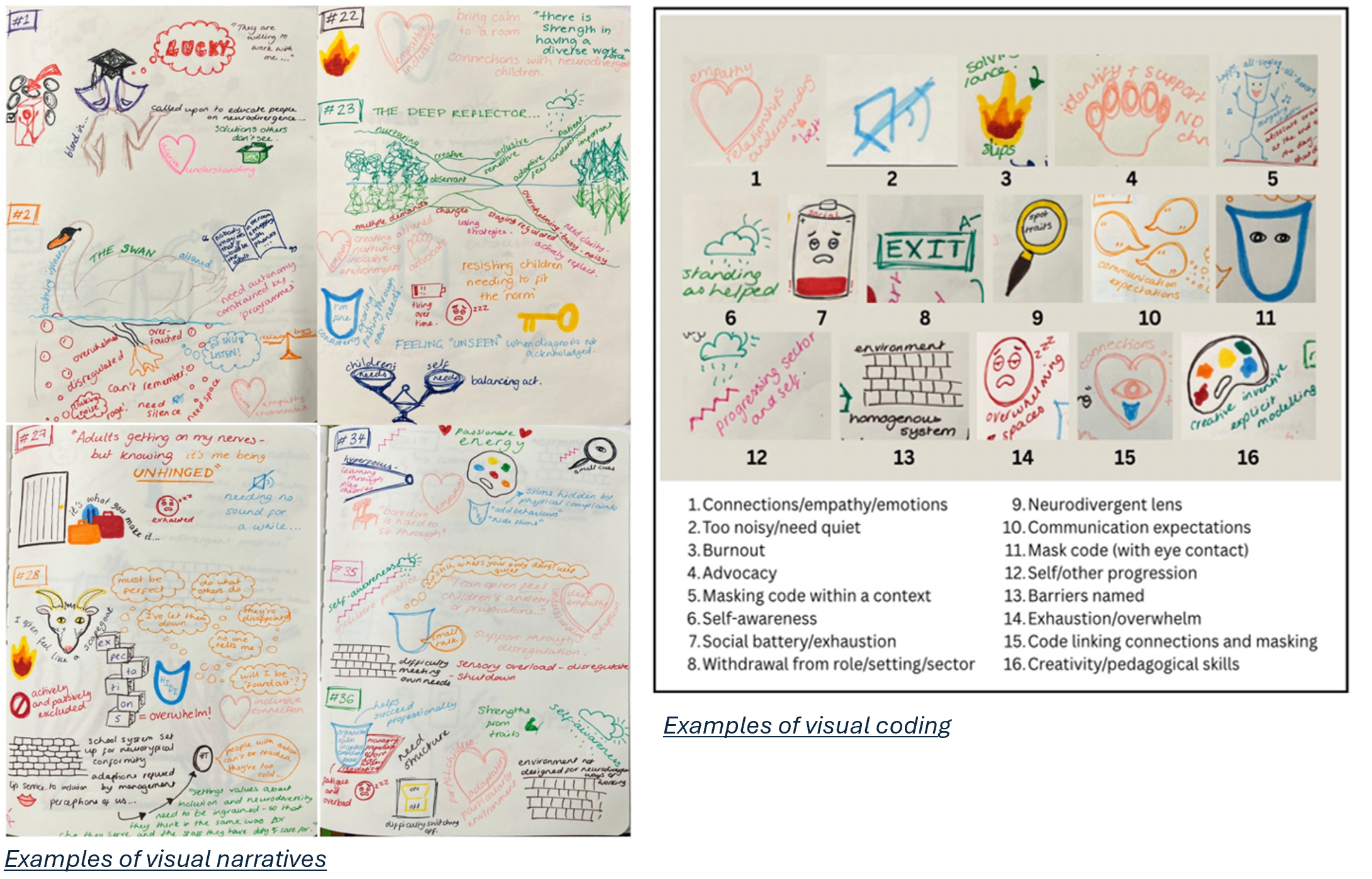
Research methods - examples of visual narratives and coding
Drawing each participant’s narrative enabled me to slow down the analysis process, support my wellbeing and reflect deeply on the complex meaning and storytelling within responses (Cabraal and Gawne, 2024). Whilst drawing, a visual coding system emerged where common words, phrases, emotions or experiences were present. This allowed me to work with my processing style, to visually see themes and patterns utilising drawing as an aid to solve problems and find solutions (Arnheim, 1969 cited in Barratt, 2024). I repeated the use of key icons where relevant and identified patterns in my use of colour which gradually moved from a subconscious to conscious decision. In this research, drawing was not only a form of creative data analysis but also crucial to supporting my own researcher wellbeing. There is scope to explore further how creative methods and arts-based research can be utilised by neurodivergent-identifying researchers.
Key messages
Both participant and researcher wellbeing are ethically important to consider, particularly in neurodivergent research.
Embedding videos into questionnaires and participant consent can support inclusion, participant-researcher relationships and informed consent.
Creative data analysis can be an effective tool for researcher-wellbeing and neurodiverse processing styles.
Find out more
I look forward to sharing more findings from the project in my upcoming conference presentation at BECERA 2026.
Connect further:
Alongside research dissemination, I offer training and consultancy focused on early years workforce development centring neurodiversity, inclusion, and neuro-affirming practice/leadership. Whether you’re interested in the research, training or partnership work, I’d love to hear from you!
Email Kay | Kay Davey on LinkedIn
References
Barratt, C. (2024) ‘Creating artworks from data’, in H. Kara, D. Mannay, and A. Roy (eds.) The Handbook of Creative Data Analysis. Bristol University Press, pp. 186–200.
Bertram, T., Pascal, C., Lyndon, H., Formosinho, J., Gaywood, D., Gray, C. Koutoulas, J., Loizou, E., Vandenbroeck, M. and Whalley, M. (2025). EECERA ethical code for early childhood researchers. European Early Childhood Education Research Journal, 33(1), pp. 4–18. https://doi.org/10.1080/1350293X.2024.2445361 .
Cabraal, A. and Gawne, L. (2024) ‘Using emoji as a creative tool for data analysis’, in H. Kara, D. Mannay, and A. Roy (eds.) The Handbook of Creative Data Analysis. Bristol University Press, pp. 201–212.
Caryll, J., Crane, L., Kenny, A., Blaisdell, C. and Davis, R. (2024) “There’s Only So Much the School Can Change About Itself … Before You Need to Change Something About Yourself”—a Qualitative Analysis of the Experiences of Neurodivergent Student Teachers. Autism in Adulthood, 7(4), pp. 435-446. https://doi.org/10.1089/aut.2024.0047.
Dark, J. (2024) Eight principles of neuro-inclusion; an autistic perspective on innovating inclusive research methods. Frontiers in Psychology, 15:1326536. Https://doi:10.3389/fpsyg.2024.1326536
Kara, H. (2020) Creative Research Methods: A Practical Guide. Bristol: Policy Press.
Kara, H. and Watts, G. (2025) Why Is There So Much Research About Us Without Us? Available at: https://isrf.org/blog/why-is-there-so-much-research-about-us-without-us. [Accessed 18 July 2026].
Lukito, S., Chandler, S., Kakoulidou, M., Griffiths, K., Wyatt, A., Funnell, E., Pavlopoulou, G., Baker, S., Stahl, D., Sonuga-Barke, E. and the RE-STAR team (2025) Emotional burden in school as a source of mental health problems associated with ADHD and/or autism: Development and validation of a new co-produced self-report measure. Journal of Child Psychology and Psychiatry, 66(10) pp. 1577-1592. https://doi.org/10.1111/jcpp.70003.
Nye, D. (2025) Using Anonymous Surveys in Research Whilst Ensuring Inclusivity. Journal of Professional Association of Teachers of Students with Specific Learning Difficulties, 38(1), pp.35-44.
Walliman, N. (2020) Your Research Project: Designing, Planning, and Getting Started. 4th edn. London: SAGE.
Wise, S, J. (2024) We’re All Neurodiverse. London: Jessica Kingsley Publishers.