By Rachel Pollard, Early Years Music and Communication Practitioner
Communication in the early years is often envisioned as a straightforward path: first sounds, then words, and finally sentences. However, for many children with Special Educational Needs and Disabilities (SEND), this journey is anything but linear. Some communicate without words, while others express themselves through movement, sound, gesture, or gaze. For many, true communication emerges most clearly when language is set aside altogether.
Over the past year, I embarked on an academic research study as part of a PGCert in Sounds of Intent, building on the focus of my MA research dissertation based on Parent-mediated practice in SEND Music intervention. This inquiry explored how music and multisensory interaction can support early forms of communication, specifically through the Sounds of Intent in the Early Years (SOI-EY) framework. My work centred on three young children with SEND, revealing a powerful insight: when we engage with children in sound, and satisfy sensory behaviours before we engage with them in words, communication begins to flourish.
Music as a First Language
For children who are nonverbal, preverbal, or who process language differently, traditional spoken communication can be demanding or even perplexing. Approaches focusing solely on encouraging words, labels, or structured language tasks often feel like pushing against a door that isn’t ready to open. Here, music provides an invaluable alternative.
Sound, rhythm, and movement precede speech in human development. Babies naturally communicate through vocal play, turn-taking, and musicality long before they can articulate words. The SOI-EY framework recognises this, viewing musical development not as an optional extra but as a vital pathway for communication (Ockelford & Voyajolu, 2020). In my research, music became a shared language and a means to connect, respond, and build relationships without relying on verbal communication.
Slowing Down to Listen
This inquiry was a formal academic research study, offering a close, reflective examination of everyday practice. Over several months, I observed three children within an early years setting, each with distinct sensory and communication profiles. Instead of structuring traditional “music lessons,” I focused on child-led musical interactions:
Following the child’s sounds and movements
Responding to their rhythms and vocalisations
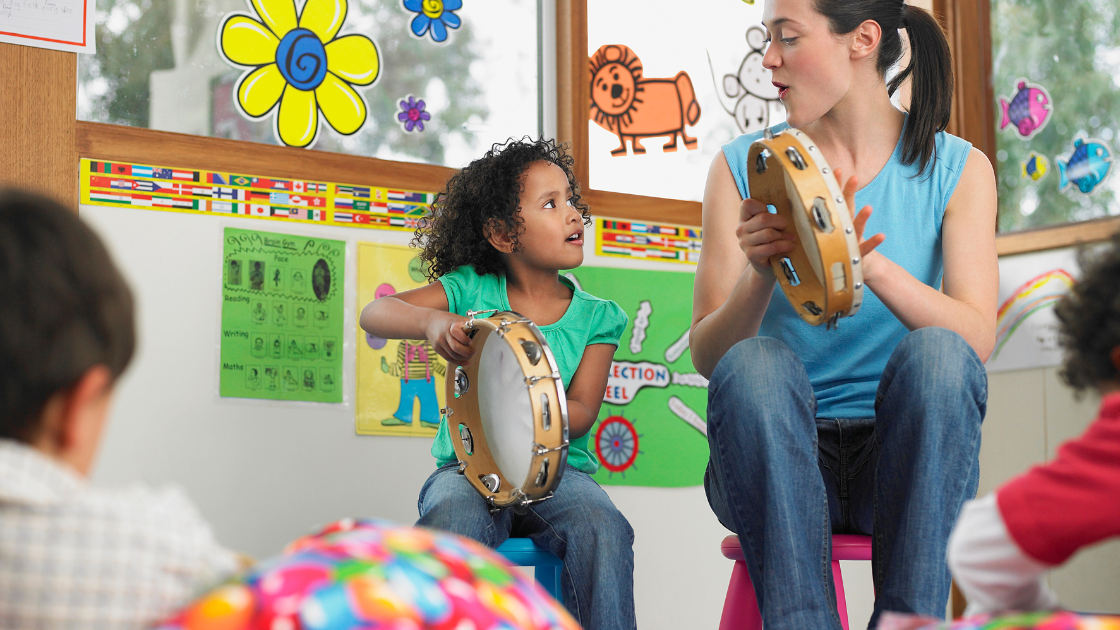
Using instruments, voice, and body percussion
Incorporating everyday objects and the environment to create musical opportunities
Allowing space for pauses, repetition, and exploration
The SOI-EY framework helped me notice small but significant moments: a child waiting for a turn, repeating a sound intentionally, making fleeting eye contact, or anticipating a musical pattern with gesture and movement. These moments, easily overlooked in a busy classroom, represent real communicative intent. I learned that meaningful communication often emerges not from doing more, but from doing less and slowing down enough to truly hear what a child is saying in their own way.
Sensory Pathways to Connection
One of the most striking themes to emerge from my observations was the importance of sensory responsiveness. Each child experienced sound, touch, and movement differently. Some sought deep rhythmic input, while others preferred gentler, quieter musical experiences. When I adapted activities to meet their sensory needs, engagement increased dramatically.
The environment played a crucial role in facilitating these interactions. Play objects, such as the ball pit and trampoline, became conduits for musical expression. Toys were placed on the drum, integrating them into the musical play and enhancing the sensory experience. For children who process the world in a sensory-led manner, communication is not solely about hearing words; it’s about feeling safe, regulated, and connected. Music can provide that regulation. A steady beat, a familiar melody, or a responsive adult voice can help a child settle into interaction in ways that spoken language alone often cannot. This aligns with findings from earlier research that emphasised the necessity of sensory-informed approaches for genuine inclusion and participation (Pollard, 2024).
What Communication Looked Like
Throughout the sessions, communication manifested in various forms:
A child pausing to listen and responding with a drum beat
Shared laughter during a musical pause
Vocal sounds and rhythmic ideas were imitated back and forth like a conversation
A hesitant child looking over to acknowledge a familiar song
Gestures, face-viewing, physical contact, responsiveness, smiles, and moments of joint attention
These were not merely “musical skills,” but social and communicative achievements — foundational building blocks for later language and relationships. The SOI-EY framework allowed these subtle developments to be recognised and valued, providing a means to document progress that doesn’t rely solely on spoken words or linear milestones.
Implications for Early Years Practice
What does this mean for practitioners? It suggests that we do not need to be music specialists to use music meaningfully. What matters most is responsiveness: noticing, waiting, and joining children where they are, not chronologically, but developmentally and in that moment. A drum, a simple song, or even just the rhythm and tone of our own voice can become powerful communication tools when used with sensitivity and care.
For settings supporting children with SEND, music can offer:
An inclusive way to participate without language
Opportunities for turn-taking and shared attention
Emotional regulation and sensory support
A joyful context for building relationships
This is particularly important for Gestalt Language Processors who learn language in a very different way. Most importantly, it reminds us that communication extends far beyond speech. When we broaden our understanding of what “talking” can look like, many more children find their voice.
References & Further Reading
Ayres, J. A. (2005) Sensory Integration and the child. Los Angeles, CA: Western Psychological Services.
Caracci, C., Martel, K. and Le Normand, M. T. (2022) The positive learning transfer from a musical play early-learning system to young children’s linguistic and spatial skills. Music Education Research, 24(4), pp. 494–511. Available at: http://dx.doi:10.1080/14613808.2022.2076820.
Crais, E. R., Roy, V. M., & Free, K. (2006). A developmental approach to communication intervention for young children with language disorders. Language, Speech, and Hearing Services in Schools, 37(1), 1-14.
Fisher, J. (2016). Starting from the Child: Teaching and Learning in the Early Years. 2nd ed. London: Sage Publications. McLennan, N. (2016). The role of musical play in child development. International Journal of Early Years Education, 24(2), 176-189.
Malloch, S. and Trevarthen, C. (2018) The human nature of music. Frontiers in Psychology, 9, Article 1680. Available at: http://dx.doi.org/10.3389/fpsyg.2018.01680
Miller, L. (2011). The Importance of Child-Led Play in Early Childhood Education. London: Sage Publications.
Ockelford, A. & Voyajolu, A. (2020). Sounds of Intent in the Early Years Framework of Musical Development. Available at: https://soundsofintent.org.uk [Accessed: 12 March 2025].
Pollard, R. (2024) How does a participatory musical play programme for parents of preschool children with speech, communication and interaction delays, support home-based musical play? A small-scale Action Research Study. Centre for Research in Early Childhood (CREC). Available at: https://static1.squarespace.com/static/60cb0edc76607f5f8959ab18/t/668fb3ab866f940393228764/1720693680264/Edited+Dissertation+for+CREC+website_RP.pdf [Accessed 12 December 2024].
Sounds of Intent (2013). Sounds of Intent in the Early Years: A Framework for Assessment and Intervention. Available at: https://soundsofintent.org.uk [Accessed: 10 March 2025].
Sussman, F. (2012) More Than Words: A parent’s guide to building interaction and language skills for children with Autism Spectrum Disorder or social communication difficulties. Canada: A Hanen Centre Publication.
Voyajolu, A. (2020). Observations of Musical Development in Early Years Children. Available at: https://soundsofintent.org.uk [Accessed: 15 March 2025].