
By Melanie Yates-Boothby, University of Wolverhampton, United Kingdom

At BECERA 2026, I’m inviting educators to explore a simple but searching question: How do you know what your classroom or setting feels like, from the perspective of the children?
In our Nursery we have been listening closely to not only words, but bodies, choices and moments of deep involvement, to understand behaviour and motivation in a setting that doesn’t use stickers, token economies or public behaviour charts.
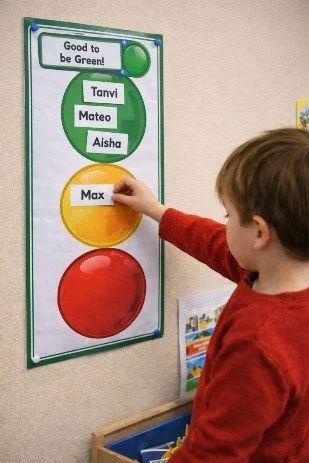
AI generated image - A child is asked to remove their name from the green circle of the class traffic light behaviour chart, and place it on the amber circle. A public display of disapproval.
Why this matters to me
My eldest son is the reason I began this journey. At four, he was wonderfully chatty, hilarious and full of beans. Yet, as an undiagnosed neurodivergent little boy, he quickly entered a cycle of never quite being good enough in school. One day, while I was out on a course, a supply teacher asked him to complete a task he didn’t understand. When he hesitated, he was told to move his name down the traffic light chart- from green to amber, then to red. By the time I collected him from the Headteacher’s office at the end of the day, he was shattered by public shaming at the hands of an adult he didn’t even know.
When I moved into leadership, I knew I wanted to end public shaming practices and rethink how we understand ‘behaviour’. I didn’t want quick fixes. I wanted relational, restorative and inclusive practices that attune to children’s lived experiences. My research journey began as an attempt to better understand behaviour through the lenses of adverse childhood experiences (ACES), trauma, neurodiversity and intrinsic motivation.

AI generated image: The adult sits with two children to play, attuned and actively listening to provide scaffolds to interactions.
From sticker queen to listening pedagogy
Early in my teaching career, I handed out stickers generously. However, as I learned more about ACES, trauma and neurodiversity, I realised that rewards can quietly coerce, undermine intrinsic motivation, and make compliance look like engagement (Deci & Ryan, 1985; Kohn, 1999). I wanted something more meaningful.
Taking the Nursery lead three years ago, gave me a chance to renew its purpose and align relational pedagogy with our restorative practice. With a newly formed team we asked a bold question: What happens to behaviour, motivation and engagement when we remove extrinsic rewards - and instead, invest in listening, belonging and autonomy?
The study: Centring children’s voices.
Research has long shown that children are better placed than adults to produce ‘situated’ knowledge that prioritises the importance of their everyday experiences (Balen Et al., 2006). Whilst many studies explore play, behaviour, mastery motivation and self-regulation (Yildiz et al, 2020), much of this work is quantitative and driven by the adult’s agenda, offering limited opportunity to understand the lived experiences of children. There is also increasing recognition that we need more effective and ethical ways to listen and hear the voices of children with additional learning needs, particularly those with complex communication difficulties.
This qualitative study explores the lived experiences of 3–4-year-olds in a nursery that doesn’t use stickers or token economies. Working as an insider-researcher, I used a Husserlian phenomenological approach with thematic analysis (Braun & Clarke, 2006) and adopted a polyvocal data collection method inspired by the Mosaic approach (Clark & Moss, 2001). Familiar child-friendly methods and resources were woven into everyday routines so that participation was inclusive by design.
Although the study engages with ideas such as mastery motivation (Józsa and Caplovitz Barrett, 2018), self-determination theory (SDT) (Deci, 1972; Deci & Ryan, 1985), involvement and flow, this blog focuses on process and purpose rather than findings. My BECERA presentation will explore how we tuned into children’s perspectives, bracketed adult assumptions, and noticed the micro-moments that often get lost when behaviour is interpreted through a compliance lens.
Why this conversation matters for the sector
In early years practice, extrinsic rewards can feel efficient for managing behaviour, but they may unintentionally reduce opportunities for genuine engagement and silence children’s inner motivations. By listening more carefully, we learn not just ‘what children do’ in our classrooms, but how our environments feel to them and how our adult assumptions can shape their experiences.
My hope is that my research sparks curiosity and courage in others; to question long standing behaviour systems in early years practice, centre children’s lived experiences and explore possibilities in early childhood classrooms where relationships, belonging, autonomy and intrinsic motivation lead the way.
Melanie Yates-Boothby is an Early Years Lead & SENCo, and a PhD research student exploring inclusion and children’s lived experiences in early years setting. You can connect with her on LinkedIn.
References:
Balen, R., Blyth, E., Calabretto, H., Fraser, C., Horrocks, C., & Manby, M. (2006). Involving Children in Health and Social Research: ‘Human becomings’ or ‘active beings’? Childhood, 13(1), 29-48. https://doi.org/10.1177/0907568206059962
Braun, V. and Clarke, V. (2006) ‘Using thematic analysis in psychology’, Qualitative Research in Psychology, 3(2), pp. 77–101. https://doi.org/10.1191/1478088706qp063oa.
Clark, A. and Moss, P. (2001/2005) Listening to Young Children: The Mosaic Approach. London: National Children’s Bureau.
Deci, E.L. (1972) ‘Intrinsic motivation, extrinsic reinforcement, and inequity’, Journal of Personality and Social Psychology, 22(1), pp. 113–120. https://doi.org/10.1037/h0032355.
Deci, E.L. and Ryan, R.M. (1985) Intrinsic Motivation and Self‑Determination in Human Behavior. New York: Plenum.
Józsa, K. and Caplovitz Barrett, K. (2018) ‘Affective and social mastery motivation in preschool as predictors of early school success: A longitudinal study’, Early Childhood Research Quarterly, 45, pp. 81–92. https://doi.org/10.1016/j.ecresq.2018.05.007.
Kohn, A. (1999) Punished by Rewards: The Trouble with Gold Stars, Incentive Plans, A’s, Praise, and Other Bribes (rev. ed.). Boston, MA: Houghton Mifflin.